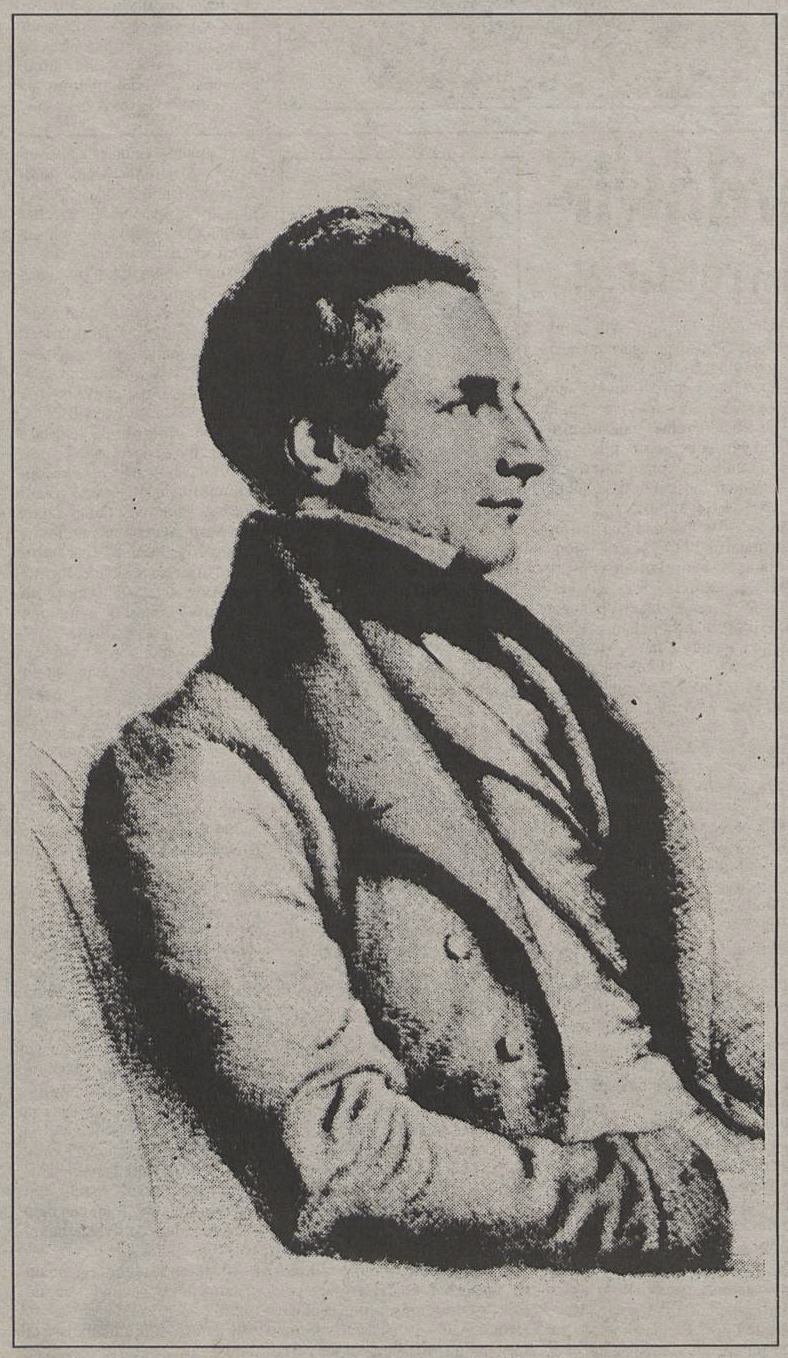
There was a showcase of a magical machine that was supposed to be able to solve equations in a matter of seconds. Murmur sang across the benches where all attention turned to the restless Charles Babbage, a math professor of Cambridge college. He was there with the results of his speculations which he planned to use to turn the world towards the future.
The chairman of the society asked Charles to take the pole, “...can thy mathematical contraption solve the following polynomial: x² + x + 41?”, Babbage walks confidently towards the machine that was compiled of gears and axles. With a few gestures he aligns the contraption and turns a handle. The hall is dead silent and listens to the cranks and clicks the gears with excitement and with a crack the solution to the equation. With thundering applause Charles Babbage is awarded with the golden medallion of the Royal Astronomical Society and a grant to continue his studies, and to fully build a computer. This was just the start for Charles of a journey to a reputational demise and financial ruin.
To realise the tailwind of Charles's operation all calculations, at that time; and before, were calculated by hand; which was expensive and time consuming. For example the French government had employed 90 mathematicians, who worked day and night, to make logarithmic tables. However there had been invented simple calculators, like the Pascaline in the 17th century, but they weren't very reliable for more complex equations. Babbage´s machine was supposed to solve whole equations in seconds.

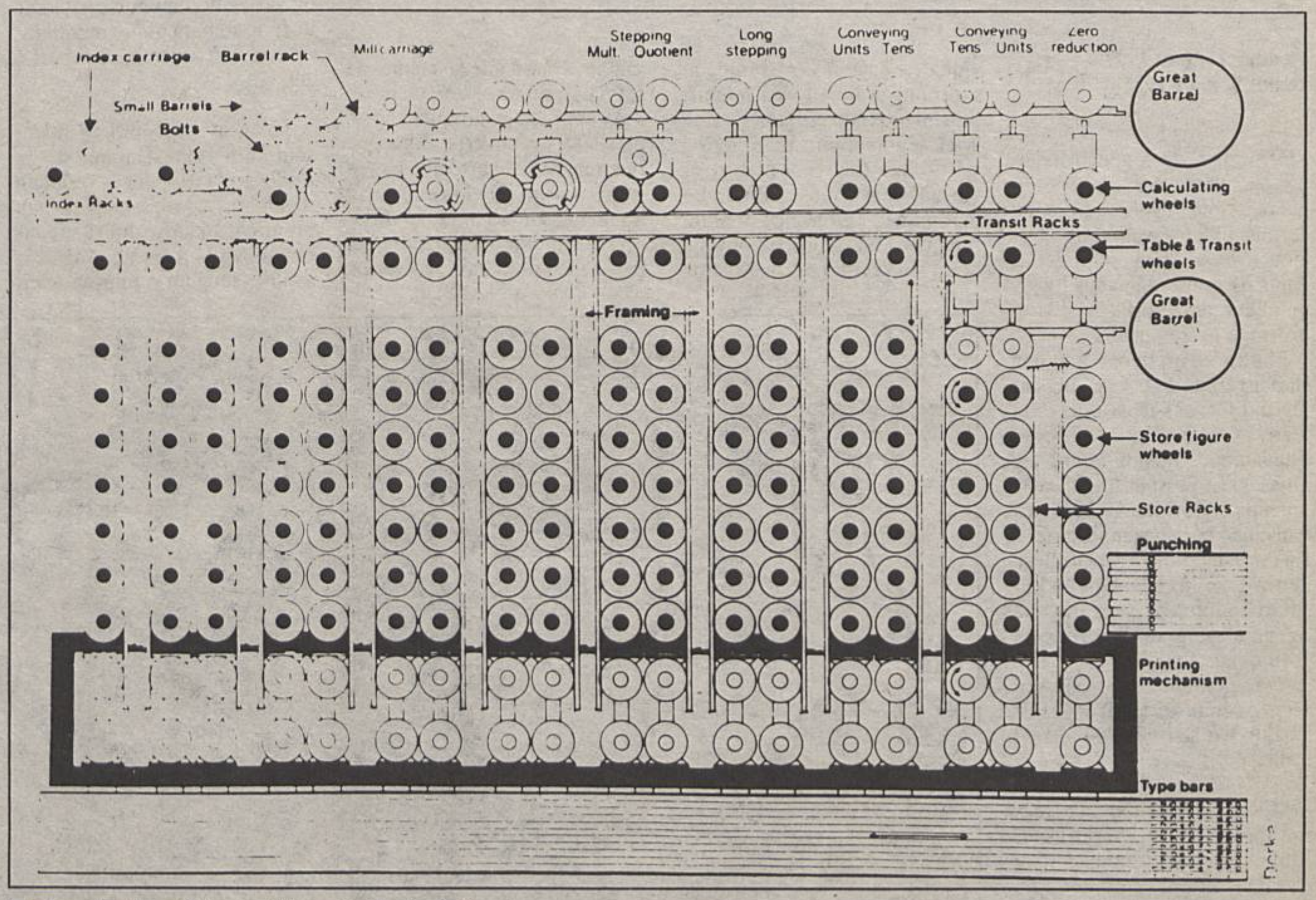
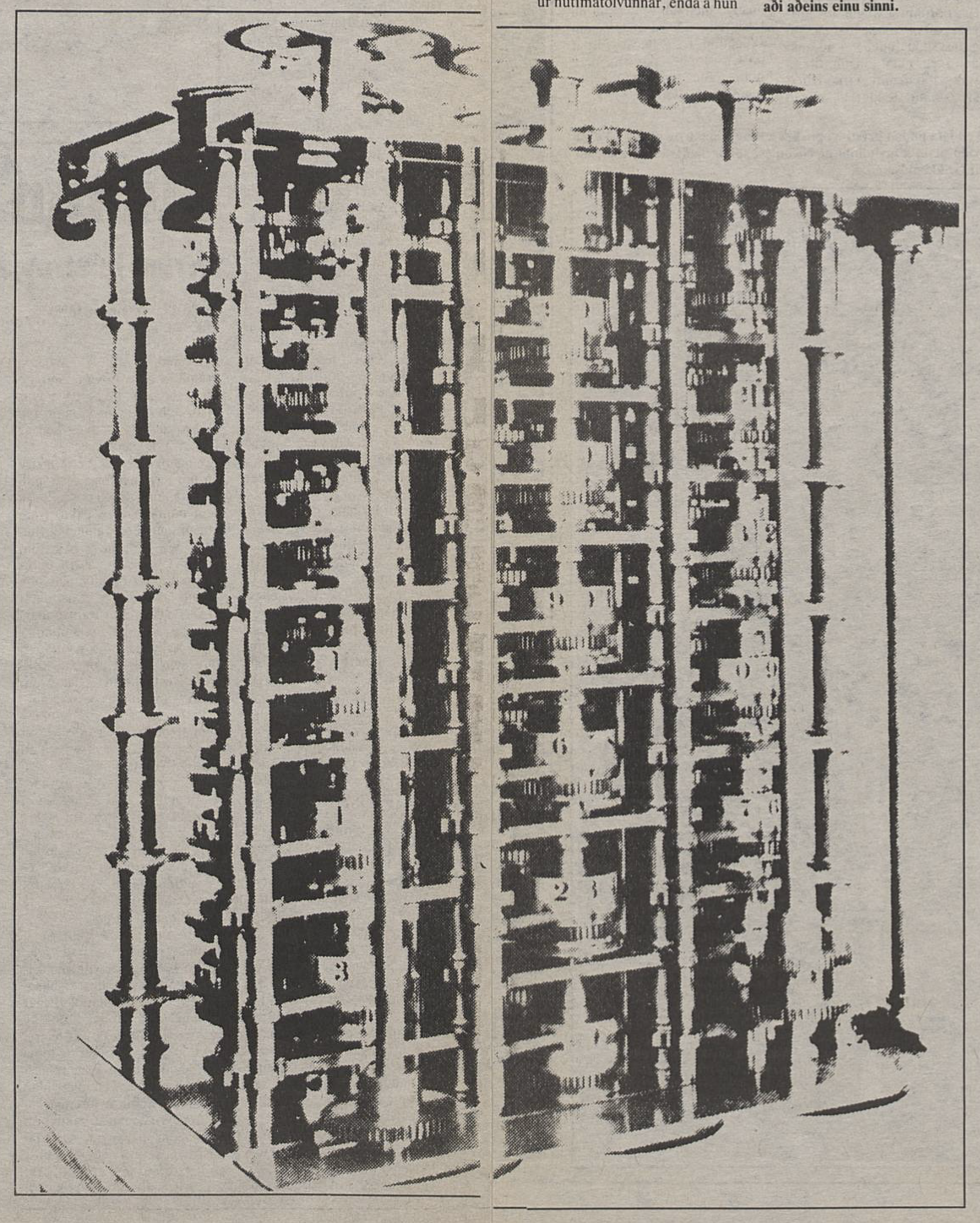
The prototype of Charles's machine was basic in its fundamentals. Gears were placed with teeths of ten and stacked on each other. When the bottom row had turned a step the next gear turned to show the dozens. When that gear has completed its round the next gear shows the hundreds etc. To be able to calculate the complex math problems, the machine was designed to do, they needed a whole lot of gears that quickly resulted in a lot of problems. In simple terms the technology of that time didn't handle its potential. A small inconsistency could multiply. It was hard to power the machine. The contraption was prone to stall, it squeaked and finally everything sat stuck. A conversation took place where they discussed connecting a steam engine to power the computer.
The work started to drag. Ten years passed without completion. Only a portion of the calculating machine was fully built. Babbage had been able to find extra donations for the project. But finally the prime minister, the Duke of Wellington, victor of Waterloo, defeator of emperor Napoleon decided to take matters in his own hands. He stormed down to Charles´s lab and inspected the battlefield. He needed a lot of explanation from Charles, but Babbage managed to convince the duke to lend him more money to do more experiments in desperation of completing the mathematical machine. But four years later Babbage stands in the same tracks and the expenses are tenfold.
The government halts the operation. The laboratory was closed and all staff members were laid off. Babbage's political career and reputation took a huge blow as his adversaries used his misdeeds as a political leverage against him, Babbage was accused of theft. A committee was set up to investigate his spendings.
But Charles Babbage refuses to throw in the towel. In April of 1834 he made a new schematic drawing for a better model of the mathematical machine! It was to be even greater than the earlier one. It was supposed to be able to solve any mathematical problem. Computer scientists view this design as the forefather of the modern computer. But the years passed. Babbage still waits for a conviction and a result of the jury so he can continue his research. In the end Charles is acquitted but his research ends. The computer is sent unfinished to the Kensington Museum.
Sir Robert Peel, the prime minister, tended to make fun of the whole ordeal and said “...the contraption would be useful if it could calculate the time it is supposed to be ready!" Then another added: “...that is impossible, it is too busy calculating the money it costs to build it.” Babbage spent his last 40 years making new designs for his machine without anyone showing it interest, except for Ada Lovelace.
Ada Lovelace was the daughter of Lord Byron. She was an adept mathematician and spent years checking Babbage's designs for errors. Though Babbage's Analytical Engine was never constructed and did not influence the invention of electronic computers, it has been recognised as a Turing-complete general-purpose computer, which anticipated the essential features of a modern electronic computer. Babbage is therefore known as the "father of computers," and Lovelace is credited with several computing "firsts" for her collaboration with him. Lovelace translated an article by the military engineer Luigi Menabrea about the Analytical Engine, supplementing it with seven long explanatory notes. These described a method of using the machine to calculate Bernoulli numbers which is often called the first published computer program. She developed a vision of the capability of computers to go beyond mere calculating or number-crunching, while many others, including Babbage, focused only on those capabilities.[7] Lovelace was the first to point out the possibility of encoding information besides mere arithmetical figures, such as music, and manipulating it with such a machine. Her mindset of "poetical science" led her to ask questions about the analytical engine, examining how individuals and society relate to technology as a collaborative tool.
Tölvubyltingin átti sér langan aðdraganda, NT
Töfrakona talnanna, Morgunblaðið